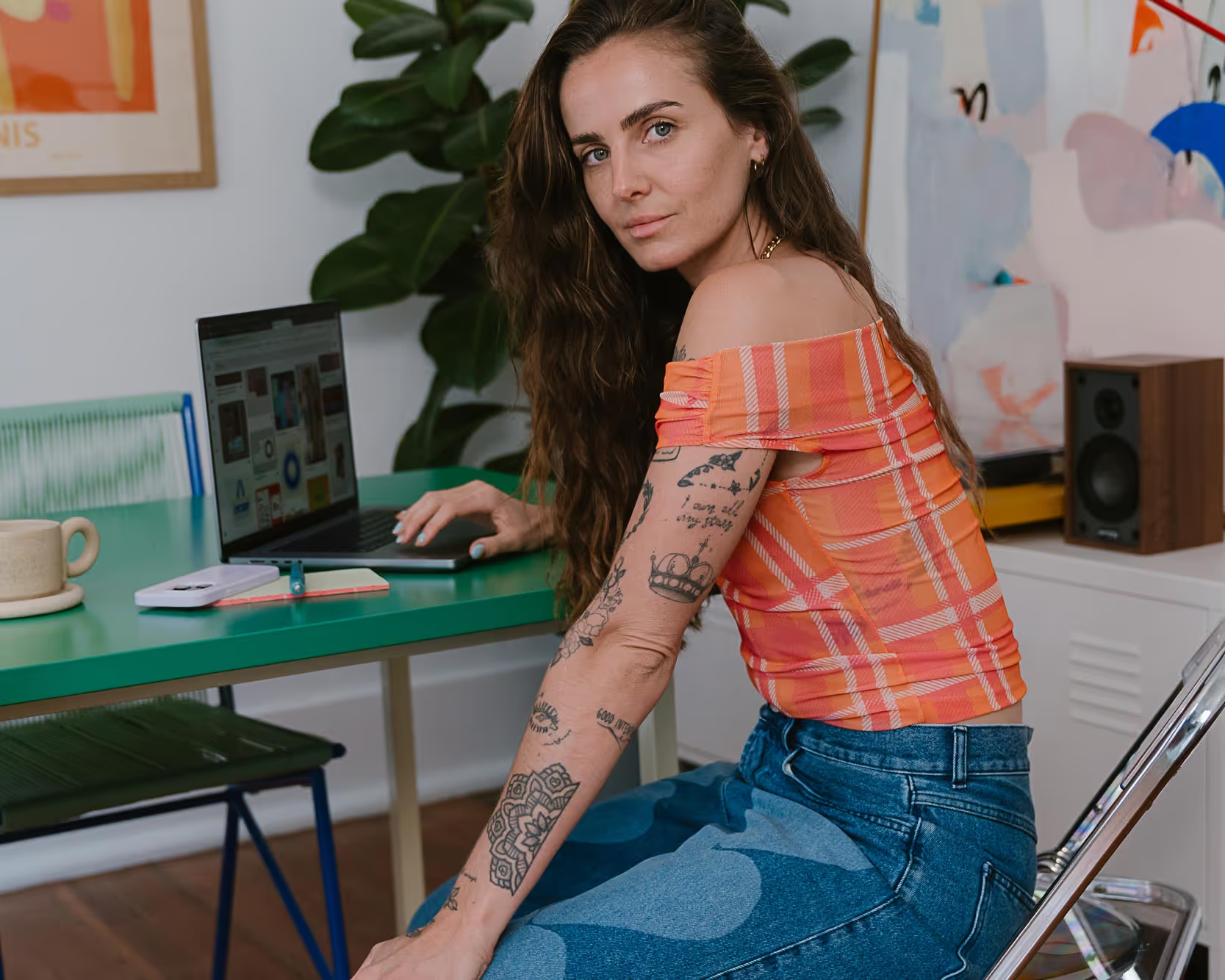
I'm Hannah May - Creative Director + Brand Advisor working with founders to turn their biggest ideas into brands that truly matter. Here is where I share the thinking behind the work. Brand insights, cultural commentary and observations from deep in the field of brand building.
2026 Marketing Shifts That Will Change the Way Your Brand Is Built

What do the 2026 marketing shifts really mean for your brand?
Most of the articles I have read are calling them trends, but I see it as a shift thats not going anywhere for a while beyond 2026. It's the beginning of a massive shift that we all need to be paying attention to as brand builders and leaders.
This moment is the result of compounded consumer fatigue, rapid cultural shifts and the acceleration of AI. We're stepping into a new era of marketing that has been quietly forming for years.
So instead of you having to sift through all the crap to find out whats actually important, I have broken down my top 4 shifts that I think are going to change the way that our brands are built at their foundations.
Is the AI slop era over?
It feels like the AI slop era is over, at least for now. People are tired of bot comments, fake campaigns, vacuous creative and chat-coded copy that's dead behind the eyes.
Trust is shifting towards brands that are clearly prioritising human-created content.
And even the largest, most coveted brands are moving away from the slop and getting serious consumer buy-in because of it.
Just look at Hermès, who recently created a campaign entirely by hand, hiring animators, illustrators and original musicians instead of defaulting to AI-generated shortcuts. That level of craft signals effort, care and trust. It shows that a brand is willing to put the work in, rather than pumping profits and getting lazy. It also feeds into the connection and analogue lives that people are craving right now.
But AI isn't going anywhere. This dip in trust is temporary and will likely become just a blip in an ever-evolving matrix. As time passes, whether that's months or decades, AI-generated content will become familiar and accepted. Which is exactly why this moment matters. There is a real opportunity right now to lean hard into human creativity while it still cuts through. So what can we do?
We can build smarter systems, automations and integrations powered by AI in the backend, freeing up more space for creativity, storytelling and human connection at the frontend.
What does this mean for your brand?
Get radically intentional about buying back your time. Use AI and automations to streamline backend processes so you can spend more energy on meaning, expression and relationships.
If you don't know where to start, go straight to the source. Use ChatGPT, Claude, Grok or your favourite friendly local robot as a thinking partner. My top recommendation is to use AI for analysis, research, structuring, sense-checking ideas, and spelling and grammar support. As well as plugging in all your business processes and asking it - how can we utilise AI to reduce friction and remove manual tasks.
For now, most of us don't need to hire an in-house AI creator or become besties with Midjourney and whatever new tool drops next week. What we do need is to increase the effort we put into meaningful stories, content, collaborations and how we show up. This means knowing your community better, leaning into your point of view and creating conversations through our brand messaging.
Why people-led brands are winning
Whether it's the rise of employee creators, the shift from influencer to expert influencer, or founders stepping fully into the role of spearhead for their brand, one thing is clear. People are what will connect and sell in this new era.
People aren't just craving human-to-human connection anymore. They're actively seeking out unique, unfiltered opinions and voices that make them feel seen. That "she gets me" connection is far more powerful than any glossy brand image or perfectly packaged hot take. They want depth. Meaningful conversation. Messy opinions. Partnerships that actually stand for something.
In a recent report by Tenet, which is worth a read if you're interested in personal brand and are a sucker for stats. 53% of consumers say they trust businesses more when there is a strong, visible personal brand behind them. And: 57% of consumers say visible and authentic leadership directly influences their purchasing decisions.
If that doesn't tell you that people are craving real, authentic leaders, and that whether you like it or not you need to be the face of your brand to get ahead, I don't know what will. People buy from faces, not faceless brands. That's always been true. But we're now in an era where storytelling, opinions, and shared values are the real differentiators.
This is where the shift gets interesting. It's less about traditional brand purpose statements anymore, and even less about polished, performative authenticity designed to tick the right boxes. We've moved past that. What matters now is realness with a point of view. We're in the era of fostering deep, meaningful connection. Of showing up fully. Of having a point of view and being okay with the fact that not everyone will agree with it. Of allowing people to drop off along the way because 100 people who hang on your every word over 1,000,000 who scroll right past is true brand resonance.
So founders need to double down on what their brand stands for, what it stands against, and communicate that clearly across every layer of their brand marketing.
What does this mean for your brand?
If you've been hiding behind your brand name and polished visuals, it's time to step onto the stage, baby. And I know this may sound scary to some. When you stop relying on your team and step into the limelight, yes, it can feel strange at first. But being visible and moving through the blocks that stop you from wanting to be there can be one of the most healing processes you'll ever go through. It can deeply change your life. I'm going through it right now, and it's genuinely profound what unfolds when you do.
Put your founder and employees front and centre by building personal brands within your organisation that reinforce the brand's realness and relatability. Run internal workshops around brand beliefs, point of view and perspective, and connect those dots back to your audience, product and offering. Then actively infuse that into your brand and marketing efforts.
It's time to take the filters off and show up as real people in a real world.
Long-form content and the multi-platform shift
We're moving from needing to hook people in within the first three seconds to earning their trust and holding their attention for fifteen whole minutes. We still need the top of funnel content to drive volume to our more intimate spaces so don't drop them all just yet, but long-form platforms like Substack and email are very much in. And email has never been out.
A report by HubSpot states that email consistently delivers higher conversion rates and ROI than both social media and search. And I can say firsthand that my emails convert significantly better than any other form of content I've put out for my own business.
Alongside the rise of long-form, we're also seeing a shift away from the advice to pick one platform and master it. We now need to be visible across multiple platforms, being seen in many places, and then intentionally taking people off unowned platforms and into owned spaces where community and conversion can take place. That means showing up where your audience already hangs out, often a mix of Instagram, LinkedIn, Substack, paid media and email, with newsletters doing the heavy lifting when it comes to conversion.
This means that the shift towards storytelling and series-led video content and culture focussed insights with POV will require more effort than before. But it also means less is more. Instead of creating endless content just to post, going deep and wide on fewer topics and infusing your brand into each piece will go much further. It's more inner-circle, IYKYK energy than clickbait hooks and spamming people with Googleable content.
What does this mean for your brand?
Using multiple platforms to create less but better content that gets people to trust you enough to get them off the apps and into more intimate spaces like Substack, or my personal preference, a newsletter.
Substack is also an amazing top of funnel opportunity, and if you love writing and are willing to put in the work it can be a platform that can drive real growth and is simple to monetise.
Instead of sending the same list of links each week on what book you are reading or a quote you saw - creating media-company-style long-form content that's varied, interesting and makes your readers feel like they're in on something no one else knows about.
People crave variation and stimulation. Testing different formats like storytelling, customer stories, interviews, short think pieces, reports, analysis or even something funny keeps attention longer and reinforces authenticity, human creation and real connection.
Also think about sub brands for your substack or newsletter, socials only assets, multiple logos, analogue elements and art direction across all of your imagery whether found or brand specific.
Why closed communities are the next frontier for brands
This shift has been happening for a while. Community is the biggest buzzword in branding right now, but it's closed, intimate, IYKYK communities that will strengthen grassroots brand support and foster deeper intimacy and connection.
The psychology of belonging is real. And people want to belong more than ever. But they're not interested in communities that feel spammy and overcrowded. And they're not interested in broadcasting with no opportunity for conversation. They want real support. Rebellious ideas that couldn't possibly be spoken about in public. Think speakeasy corners. Private, late-night group landline calls with your girlfriends. The best-kept secret that everyone wants to talk about. That's the energy we should be creating around closed communities.
Spaces people feel proud to be part of. Spaces that actively support their identity.
Think free broad OR hyper/niche WhatsApp groups, and paid circle communities. OOH (out of home) meet ups and invite only events. I started my own closed community last year for designers, and it's become my favourite part of my business. I've created a whole new part of my business that is the proudest thing I have created and will be sharing about how I did it soon.
What does this mean for your brand?
Creating community is hard. And don't let anyone tell you otherwise. Closed communities won't work for everyone but fostering community within your brand is available to all.
Look at your business as a whole and ask whether there are micro-communities with a single, shared need that you could facilitate. If it's not there, don't force it. You could try and get your whole audience into a private space, but you need to give them a reason to join. Communities take time to build and only thrive when there's real member-to-member engagement.
So there will be an initial period where you will need to be present as the facilitator, encouraging conversations between people in order for it to becomes its own entity.
How I would suggest starting this from my own experience is start small. A close friends stories group, an instagram chat off the back of an event which brings likeminded people together, a closed whatsapp group for customers to connect. Also don't think that you need to monetise your community at the start or if at all. It could just be another layer to nurture for people to buy your main products or services. Think about a free event or IRL experience that can bring your brand to life thats unexpected and not mass market.
This is a super exciting time for the Founders and Brand leaders in our space. The ones that want to create real connection. To better the lives of others and are creating the change they want to see in the world. It's also going to require a shift in strategy and mindset when it comes to building our brand and marketing it to our audience.
Want the full breakdown with implementation plans? Download the 2026 Social Brand Identity Playbook for the complete roadmap.
Frequently Asked Questions
Use AI for backend operations like research, analysis, scheduling and process automation. Then redirect the time you save into storytelling, creative direction and building real relationships with your audience. Your brand stays human when AI handles the tasks, not the voice.
No. Show up where your audience already spends time, then focus your effort on moving them into spaces you own, like a newsletter or closed community. Two or three platforms done well with intentional cross-promotion will outperform five done on autopilot.
Start with a small, low-friction space like an Instagram close friends group or a WhatsApp chat tied to a shared interest. Give members a clear reason to join and show up as the facilitator until organic conversations start happening between members. Scale only after real engagement takes root.
You May Also Like
How to Create a Brand Identity Your Audience Is Obsessed With
Your brand identity should make your audience obsessed with everything you do. Three strategies for creating visual identities that resonate and attract the right people.